


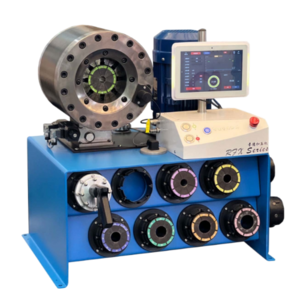
The hydraulic hose assembly industry is undergoing a significant transformation driven by Industry 4.0 principles. Smart crimping technology — exemplified by the RFX series of intelligent crimping machines — represents a leap forward from traditional manual and semi-automatic crimpers, delivering unprecedented precision, traceability, and operational efficiency for hydraulic and pneumatic hose assembly operations.
The Evolution of Crimping Technology
Traditional crimping machines rely on operator experience and manual adjustments to achieve acceptable hose assembly quality. The operator measures the crimp diameter using a caliper after each cycle, then fine-tunes the machine settings iteratively. This approach is not only time-consuming but also introduces human error and inconsistency across different shifts and operators.
The RFX series changes this paradigm entirely. By integrating digital position sensors, closed-loop servo control, and adaptive crimping algorithms, these machines automatically calculate and execute the optimal crimp parameters based on the hose and fitting specifications. The operator simply scans a barcode or selects the assembly profile from the touchscreen interface, and the machine handles the rest.
Key Features of Smart Crimping Systems
Modern intelligent crimping machines incorporate several advanced technologies. Precision linear encoders provide real-time feedback on die position with accuracy down to 0.01 mm. Servo-electric drive systems eliminate the variability associated with hydraulic systems, maintaining consistent force and speed throughout each crimping cycle. Touchscreen HMIs with intuitive workflow guidance reduce training time and minimize operator errors.
Built-in quality verification is another hallmark of RFX-class machines. The system automatically measures the final crimp diameter and compares it against the specification. If the result falls outside the tolerance window, the machine alerts the operator and can optionally lock the assembly until corrective action is taken. This closed-loop quality assurance dramatically reduces the risk of field failures and warranty claims.
Data Logging and Traceability
Perhaps the most transformative aspect of smart crimping technology is full data traceability. Each crimping cycle generates a complete digital record: operator ID, date and time, hose and fitting part numbers, programmed and actual crimp diameters, crimp force profile, and cycle count. This data can be stored locally or transmitted to a cloud-based MES platform for real-time production monitoring and analysis.
For industries such as mining, construction, and oil and gas — where hose failure can result in costly downtime and safety hazards — traceability is not just a convenience but a regulatory and insurance requirement. Smart crimping systems provide the documentation needed for ISO 9001, ISO 14001, and OHSAS 18001 compliance audits without additional paperwork.
Operational Efficiency Gains
The productivity improvements from smart crimping technology are substantial. Setup time is reduced from several minutes to seconds when using barcode-based profile selection. The elimination of post-crimp manual measurement saves an additional 10-15 seconds per assembly. For facilities producing thousands of assemblies per month, these savings compound significantly. One documented case study from a hydraulic service center in Germany reported a 35% increase in throughput after upgrading from manual crimpers to RFX-series machines.
Predictive maintenance capabilities further improve uptime. The machine monitors its own operational parameters — motor current, bearing vibration, cycle count — and alerts maintenance personnel before components reach end of life. This reduces unplanned downtime and extends the service intervals for critical components.
Future Outlook
As the Industrial Internet of Things (IIoT) continues to expand, smart crimping systems will play an increasingly central role in the connected factory. Future developments are expected to include AI-driven parameter optimization that learns from historical quality data, wireless connectivity for mobile crimping stations, and automated tool changers that enable fully unmanned hose assembly cells. Forward-thinking operations that invest in today’s smart crimping technology will be well-positioned to capitalize on these advances.
The RFX series and similar smart crimping machines represent a fundamental shift in how hydraulic hose assemblies are manufactured. By combining precision servo control, built-in quality verification, full traceability, and IIoT connectivity, Industry 4.0 crimping technology delivers measurable improvements in quality, efficiency, and compliance — making it an essential investment for modern hose assembly operations.